My favorite new gadget is 7 years old and it’s how I stopped letting AI write for me
There’s good intentions behind why people start using AI to help them write. Usually it’s because they struggle to sit down and write or the actual formation of thoughts is hard for them on a set schedule. All these are why I’ve struggled to get things down on paper before.
September 1, 2026
There’s good intentions behind why people start using AI to help them write. Usually it’s because they struggle to sit down and write or the actual formation of thoughts is hard for them on a set schedule. All these are why I’ve struggled to get things down on paper before.
Here’s the thing though: writing about my work is my favorite medium to share my work.
Especially when it comes to what’s technical because as much as I love a good Youtube video if you tell me something complicated I’m going to have to go back over it 2–3 times before it really lands.
So, to fix that, we’ve got two problem we’re going to solve for today: it’s a struggle to sit down and write (I’ll do it later turns into never) and it’s hard to form the thoughts (so hard to write the story).
That translates into two solid goals:
Make it easy to start writing
Make it easier to write
Easier for writing because I personally never think it’ll feel easy but starting should.
The $0.25 experiment
There’s been more and more controversy around pangram as it’s both become more popular and more widely used at the same time. But it’s still a better way than most at saying “will most people or apps think this is AI written?” and because of that Pangram is where I started. At the very least it helped me confirm some thoughts.
I tried all the things you hear about if you’ve been around the AI space at all the last few years. Feeding it all my emails, re-writing things, telling it to never ever commit the sin of using a em dash (I’m sorry professional real writers).
Guess what always happened? It always came back as 100% AI.
Do you know why? Because it was written 100% with AI. The thing is even if you found a way to beat a system monitor like Pangram there is one reality if you’re letting AI write: it’s still going to be 100% written by AI. No matter what.
And funny enough, this was an insight that Claude brought up first. I was pushing back on trying to pass this test and Claude said: “It’s coming back as 100% AI because I wrote it”. It’s like the very obvious answer a toddler gives you when you overcomplicate something. “Just don’t be mad” problem solved.
The whole experiment cost a mere $0.25 and left me with this thread to pull on next: If AI can’t write for me, what can it do to help?
Remember our goals are:
Make it easy to start writing
Make it easier to write
Making it easy to start by going way back
I’m great at getting lost in a task and usually terrible at getting it started. There’s typically two ways to fix this: force it with something (deadline, or some external pressure), or make it so small that starting is a very tiny task.
Some examples of our options:
Forcing would be a deadline with an external force. Maybe a co-worker or boss typically. A reason it has to get done today so it must be worked on today. Biggest challenge here is when you don’t have co-workers or a boss. Giving yourself fake deadlines requires a certain type of personality (one I don’t have).
Making a task small includes any version of it that’s a start. The smallest of these is if I have to work on a design and I know the start of that task is in Figma the starting first task is simply: Open Figma. So we’re talking very very small.
The reason the small can work is that it gets the ball rolling. Where it falls apart is, for our purposes, if it’s just “Open a blank page” it’s not super helpful. I don’t know if you’ve ever sat down to write to a blank page but it’s pretty miserable.
So let’s go back. What’s before sitting down to write? We have to have something to write about. For me, those come at totally random times and span all sorts of topics.
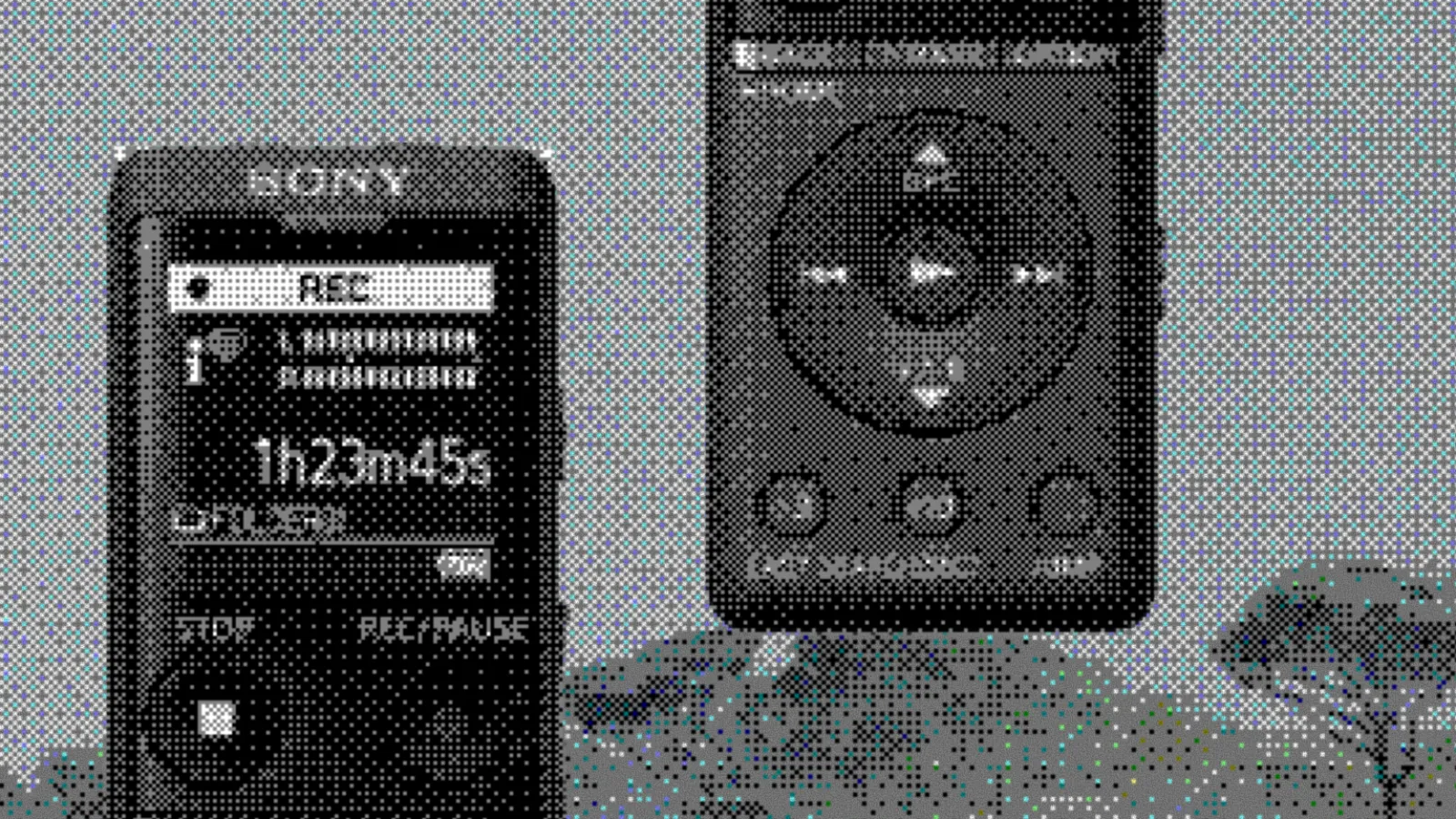
Enter the little Sony IC Recorder. Specifically the ICD-UX570 but the model doesn’t matter at all. This specific one was made 7 years ago. It has a USB A popout port built in that’s honestly a fun fidget. But the important detail is this: it records. That’s all we need. Any little device that records.
What’s nice about a separate device is I can go on a walk or grab it in the car and do nothing with software or tagging or anything I just turn it on and talk.
We’re closer to solving for our first goal. We’ve made it easy to collect and store the ideas but what about that blank page?
Making ideas effortless
Here’s where we’re starting to add the fun technical details (if you’re nerdy like that). We’ve got a bunch of data on a digital recorder but what are we supposed to do with that listen back to it? I don’t want to hear myself talk. Transcribe it ourselves like we’re in the stone-age? Absolutely not.
The good thing is these are two super simple problems with software using AI to help us if we don’t know the code ourselves. We’re detecting a device is connected to computer and when it is we want to transcribe the audio files. Few bonus things for good measure: this recorder has a external micro SD card so that shows as a second device on the computer and it’d be nice to eject the device when we’re done with it. Both of these are super common so they’re not hard to write scripts for (even if you don’t do this all the time).
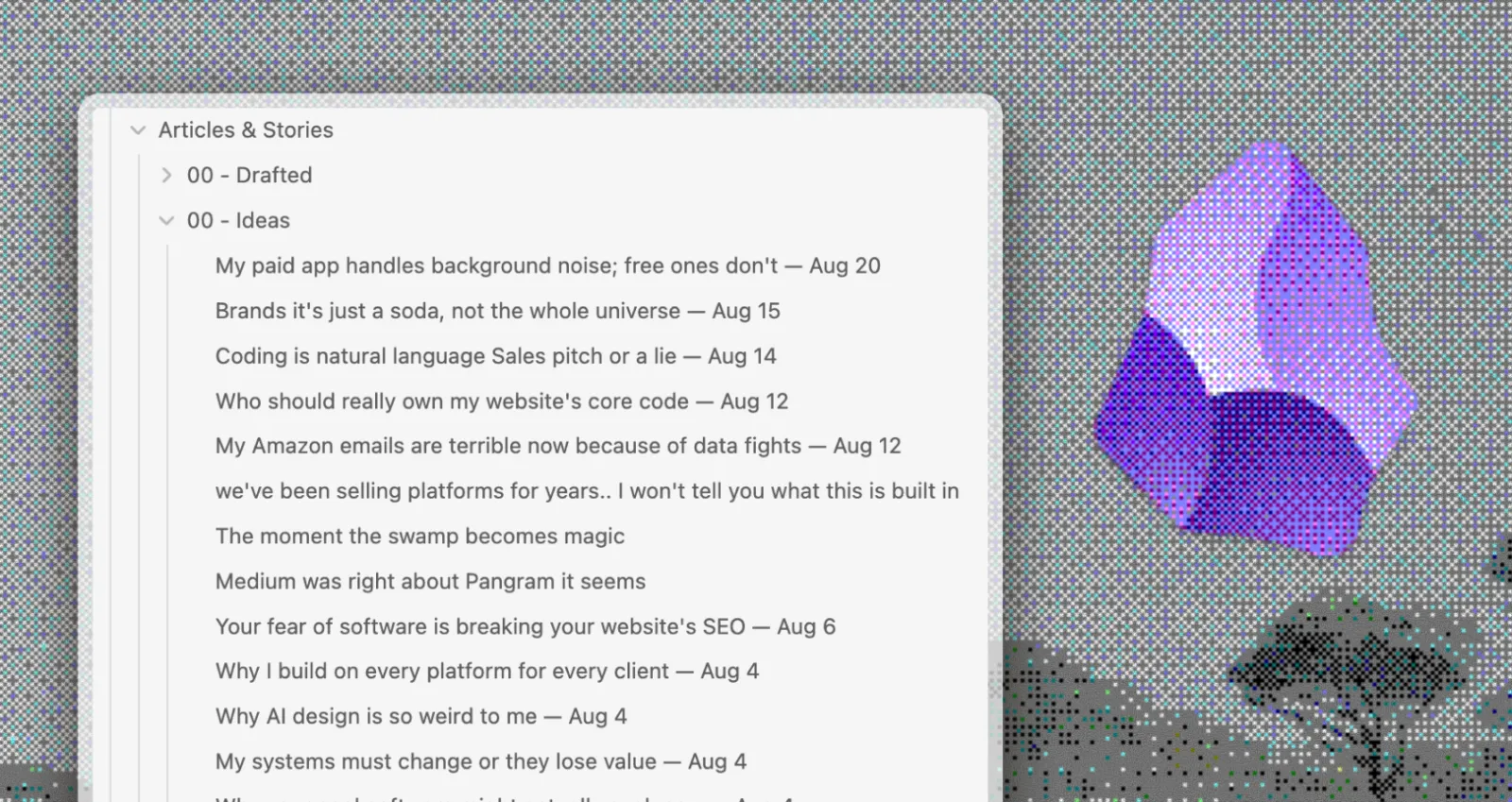
On where they go: I put them in my obsidian because that’s where I write an idea by hand if I ever feel like doing it that way and all my other notes are in here. What this is in doesn’t matter though.
So now we’ve got a bunch of ideas as text files somewhere on our computer. Let’s organize them get rid of that blank page.
Robots, you may enter
Now we have ideas, they’re written down and they’re organized! We’re getting closer.
Let’s pull these into something that eliminates that blank page now. We’ve got everything we need for it.
Enter a simple application that’s ugly (by my standards) and it exactly I needed to eliminate that blank page.
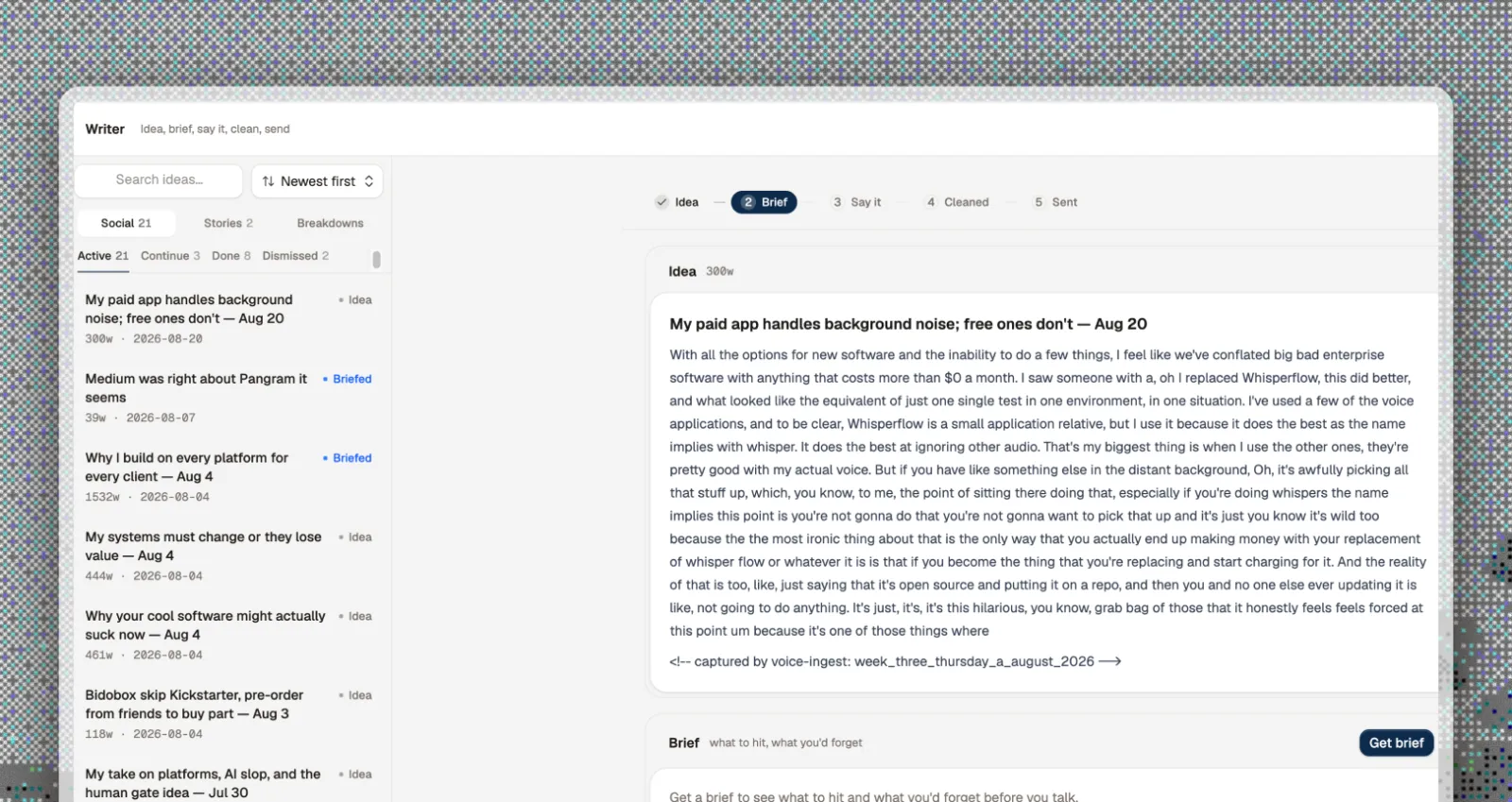
It pulls those documents we’ve transcribed and you can see they’re just a big wall of text. That’s exactly how we said them into our recorder so there’s no getting around that. But this is where we can start using some AI to help us clean this up.
Important note: It’s tempting at this point to let AI write the post or article for us but we determined earlier that’s never going to give us the output we want so we need to keep AI in it’s lane of not thinking for us, just helping us do the thinking easier.
So the first thing AI is doing to do is give us a brief. This Brief specifically is just helping us organize our thoughts and gives suggestions of things to hit (which is why this phase after getting a brief is “Say it”).
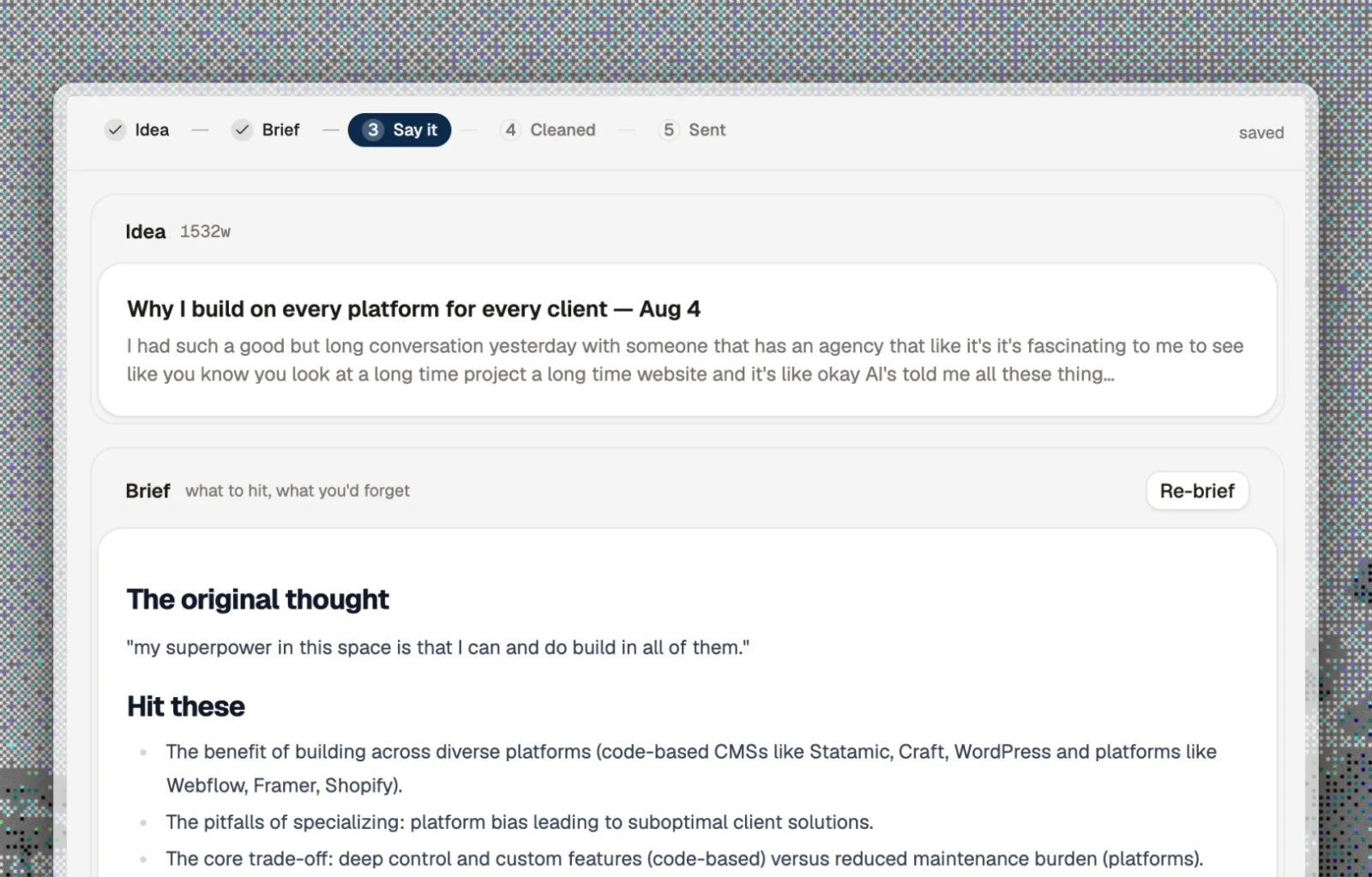
It’s pulling what it things is the core thought and some bullet points you can hit if you want just base don what you said in the original idea.
You’ll notice there’s no “You should do this structure” or “Here’s the hook” and absolutely no “Here’s the point” mentions from this brief.
This one that’s pulled us actually a great example. I did say those words in the idea but that’s not where I ended up going with that idea in the final post. And that’s kind of the point! A benefit of this is it’s giving me a chance to think about what I originally said with a fresh set of eyes and I can focus on whatever I want to focus on.
From there we’re in all the easiest steps. From that brief we’ve give ourselves an easy list to talk about and focus on from our original idea. This next phase just cleans our text making sure we don’t do any silly spelling errors or something obvious like that. Here’s a real example:
cleaned.png
You’ll notice there’s a point where it wanted to add a line but it has specific rules around not doing this. Again this is where “Don’t think for us” is key. It’s giving me a vague suggestion to “make this clearer” but that’s it. I can take it or leave it and if I try to make that clearer it’s my own words by design.
From there an easy step of confirmation and sending it to my schedule app of choice Typefully even though I’m only really posting to linkedIn so that could be done with a simple added feature down the line.
The cost of not doing it this way
We’ve now solved both our goals we started with of making it easy to start writing and making it easier to write.
And all with a very tiny amount of AI and some good software around what we’re doing. Oh and an old digital recorder (this one isn’t really very old but it could be a 20 year old recorder as long as it’s digital).
Not doing this could mean 10x the output but for sure it means 100x the likelihood I’d skip over this content or at the very least hit those new “AI slop” buttons when coming across this content. Obviously I want to put out content that I’d enjoy but while I’m at it I might as well make things easier on myself.
100% less friction. 0% AI thinking for me.